
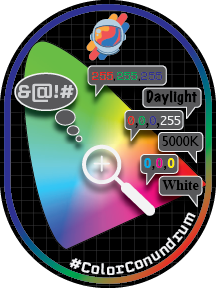
#ColorConundrum
Hi, friends and colleagues!
I think we have a wee bit of a problem with how we document and talk about color.
That problem shows up in communication between…
Designers and Programmers
Designers and Manufacturers
Designers and Clients
Designers and Collaborators
and increasingly - Designers and Designers.
Not very long ago, lighting teams defaulted to gel colors as a shared shorthand for intent: “Roscolux 80,” “LEE 79,” “GAM 850,” “Apollo 4250.” Those references carried an implied context - a known light source (tungsten, halogen, HMI, etc) paired with a subtractive material.
This worked because the ecosystem was relatively constrained - There were only so many lamp manufacturers, making a limited range of spectral distributions. This created a fairly predictable relationship between source, color filter, and output.
This expanded into color scrollers, color wheels, and Cyan/Magenta/Yellow subtractive mixing systems.
With the industry’s shift to LED sources, our color-mixing methodology changed almost overnight - from primarily subtractive systems to overwhelmingly additive ones. That transition happened faster than our shared vocabulary evolved to support it.
In some ways, advances in control technology offer the illusion that these issues have been solved. Consoles present color pickers, virtual gels, and chromaticity diagrams that imply a clear understanding of a fixture’s capabilities.
In reality, these representations are often approximations. They typically don’t account for factors such as dimming behavior, power correction factors, thermal interference, channel interactions, or lumen output.
The result is a massive increase in complexity surrounding the matching of fixtures to each other and our ability to describe what we want to see coming out of each light.
Over the past few months, I’ve had this conversation with a wide range of lighting professionals. We’ve mostly come to the conclusion that we’ve got more questions than answers.
Can we still use the names/numbers of gel colors?
Does the up-n-coming generation have gel colors memorized?
How do we ask for tweaks (More red? Less cyan?)?
How does a White, Amber, or Lime LED change the process?
What are we asking of manufacturers to make this process better?
Does architecture have the same challenges as entertainment?
How can consoles be improved to make this process better?
I’d like to investigate further! Would you be willing to share some of your thoughts?
Thank you!
Chris Werner - Lunar Telephone Company
If you’re a lighting manufacturer or a console developer, PLEASE join the conversation!
I’d LOVE to have a more substantive discussion with you and your team. I’d even be happy to share the data from this 1st round of info gathering.
Contact me via missioncontrol@lunartelephone.com.